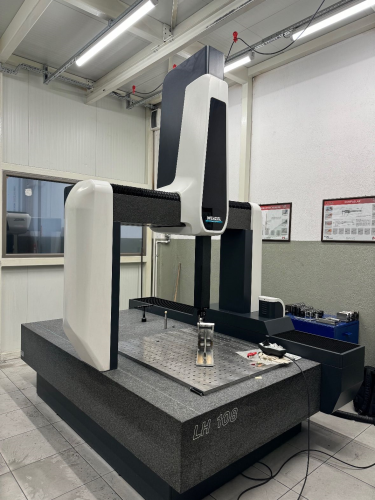
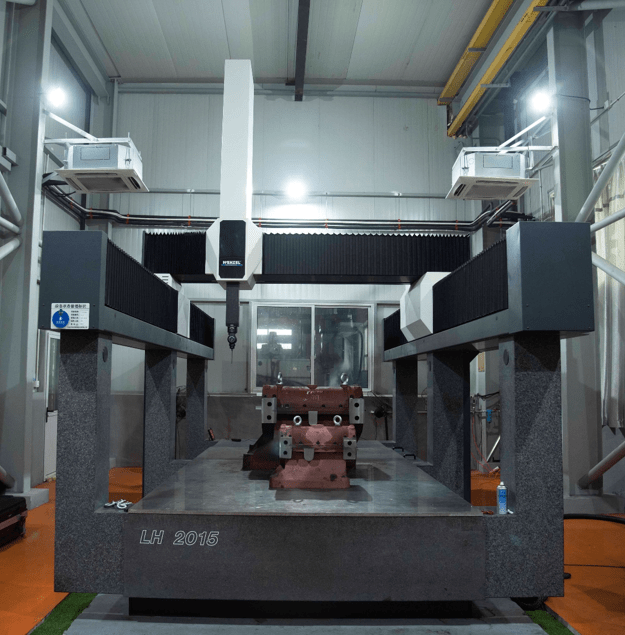
A CMM can continue to operate accurately even after many years of use. But does the technology on that machine still meet your company’s current measurement and inspection requirements?
Products change. Customer requirements change. Inspection standards change. Manufacturing processes change. And, most importantly, measurement technology continues to evolve.
Therefore, when a Coordinate Measuring Machine (CMM) has been in operation for many years, businesses do not necessarily have to choose between simply continuing to use the old machine and investing in a completely new system.
Another option worth considering is CMM Retrofit – upgrading the existing CMM system.
What Is CMM Retrofit?
CMM Retrofit is the process of upgrading one or more components of an existing Coordinate Measuring Machine to improve its measurement, control, data acquisition, and data processing capabilities.
Instead of replacing the entire system, businesses can evaluate the actual condition of the machine to determine which components need to be upgraded and which components can continue to be used.
Depending on the machine’s age, configuration, and condition, a CMM retrofit program may include:
🔹 Upgrading the CMM controller
🔹 Replacing or upgrading probes and sensors
🔹 Updating measurement software
🔹 Upgrading the computer system and data interfaces
🔹 Improving data acquisition and processing capabilities
🔹 Integrating new measurement technologies
🔹 Testing, calibrating, and reassessing measurement performance after the upgrade
The goal is not simply to make an old machine “run again,” but to bring the measurement capabilities of the existing system more closely in line with current production requirements.
When Should a Business Consider CMM Retrofit?
Not every older CMM needs to be retrofitted. Conversely, even a relatively newer machine may need to be assessed if it no longer meets current production requirements.
Some signs that a business should consider CMM upgrades include:
1. The CMM Still Works, but Its Technology Is Outdated
The mechanical structure of the machine may still meet requirements, but the controller, computer, software, or data interface may have become outdated.
This can make operation, maintenance, or connection with current data-management systems more difficult.
2. Measurement Requirements Have Changed
A business may now be manufacturing products with:
- More complex geometries
- Tighter tolerances
- More features requiring inspection
- Higher automation requirements
- Greater data acquisition and analysis requirements
A CMM that performed well in the past may not necessarily meet all current requirements.
3. The Probe or Sensor Is No Longer Suitable
As measurement applications change, the probe configuration may also need to change.
Upgrading to a suitable probe or sensor can expand the measurement capabilities of an existing CMM without necessarily requiring the entire machine to be replaced.
4. The Measurement Software No Longer Meets Requirements
Software is an important part of the entire CMM measurement process.
If a system is running outdated software, businesses may encounter difficulties with:
- Measurement programming
- Data analysis
- Measurement program management
- Report generation
- Data connectivity
- Integration with manufacturing and quality management systems
In such cases, CMM software upgrades may be one of the areas worth evaluating.
What Are the Benefits of CMM Retrofit?
Extending the Service Life of an Existing CMM
If the machine structure remains suitable and meets the necessary technical requirements, a retrofit can help businesses continue to leverage the value of their existing system rather than replacing the entire equipment.
Improving Measurement Capabilities
Upgrading the controller, probe, sensor, or software can help make the system better suited to new measurement and inspection requirements.
Reducing the Need for a Complete Replacement
Rather than assuming that an older CMM must be completely replaced, businesses can evaluate each component of the system and determine the scope of upgrades that is actually required.
This can be particularly worth considering for businesses that have CMMs with mechanical structures that remain in good condition.
Improving Adaptability to New Technologies
Measurement technology continues to develop with solutions such as scanning, optical measurement, automation, and digital inspection.
Depending on the configuration and upgrade capabilities of the individual system, a retrofit may provide opportunities to integrate selected new technologies.
Does CMM Retrofit Mean Replacing the Entire Machine?
Not necessarily.
This is one of the most important points when evaluating a CMM retrofit solution.
Retrofit is not simply about “repairing an old CMM.” It is a targeted process of evaluation and upgrading.
A system may only require:
Software upgrade → improving measurement programming and data processing capabilities.
Or:
Controller + computer upgrade → improving system control and operation.
Or:
Probe/sensor upgrade → expanding measurement capabilities.
In other cases, a business may need to combine several upgrade components.
The scope of the retrofit should be determined based on the actual condition of the machine, measurement requirements, and the company’s investment objectives.
CMM Retrofit or a New CMM?
This decision should not be based solely on the age of the machine.
Businesses should consider at least the following factors:
| Criteria | CMM Retrofit | New CMM Investment |
|---|---|---|
| Existing machine | Can potentially continue to be used | Replaces the existing system |
| Mechanical structure | Must be assessed for continued use | New system |
| Technology | Upgraded according to the required scope | Complete new technology |
| Investment scope | Can focus on the components that need upgrading | Investment in the complete system |
| Implementation time | Depends on the retrofit scope | Depends on configuration and installation plan |
| Expandability | Depends on the existing machine configuration | Configuration can be selected from the beginning |
| Investment efficiency | Depends on machine condition and upgrade scope | Depends on requirements and new system configuration |
There is no single solution that is suitable for every business.
The key is to evaluate how far the existing CMM can meet current requirements and what the gap is between its current capabilities and future measurement needs.
The Key Question Is Not “How Old Is the CMM?”
A CMM may have been in operation for many years and still retain significant value if its mechanical structure and measurement capabilities remain suitable.
Conversely, a relatively newer system that no longer meets current measurement and inspection requirements can also become a bottleneck in the quality control process.
Therefore, instead of simply asking:
“How many years has our CMM been in operation?”
Start with a more important question:
“Does our current CMM still do everything we need it to do?”
This is the basis for determining whether a business should continue using the existing system, retrofit, upgrade, or invest in a new CMM.
GERA Hi-Tech – CMM Upgrade and Optimization Solutions
With experience in metrology and inspection, GERA Hi-Tech can support businesses in evaluating their CMM systems, current requirements, and potential upgrade options.
Rather than applying the same solution to every machine, the evaluation should start with:
Existing machine → System condition → Current measurement requirements → Future requirements → Appropriate upgrade scope.
Based on this assessment, businesses can consider options such as:
Maintenance → Repair → Upgrade → Retrofit → Or investment in a new CMM.
The ultimate goal is not simply to own newer measurement equipment, but to build measurement capabilities that are aligned with the actual manufacturing process and quality requirements.
Is Your CMM Ready for Its Next Step?
If your business has a Coordinate Measuring Machine (CMM) that has been in operation for many years and is experiencing challenges related to the controller, software, probe, measurement capabilities, or ability to meet new inspection requirements, consider evaluating the possibility of a retrofit before deciding to replace the entire system.
👉 Contact GERA Hi-Tech for consultation and assessment of a CMM upgrade solution tailored to your existing system.
GERA Hi-Tech – Accuracy – Transparency – Partnership – Expertise.